Warg
A Clash of KingsWarg is a human shapechanger whose soul can reach an animal and experience the world through it. In the evidence surrounding Bran Stark and Jon Snow, the term names neither an ordinary dreamer nor a mere lover of animals, but a person possessing a power that crosses the boundary between human consciousness and animal life. That power is first encountered through wolf dreams, where running, hunting, fear, pain, and separation become bodily experiences rather than detached images.
Definition and Recognition
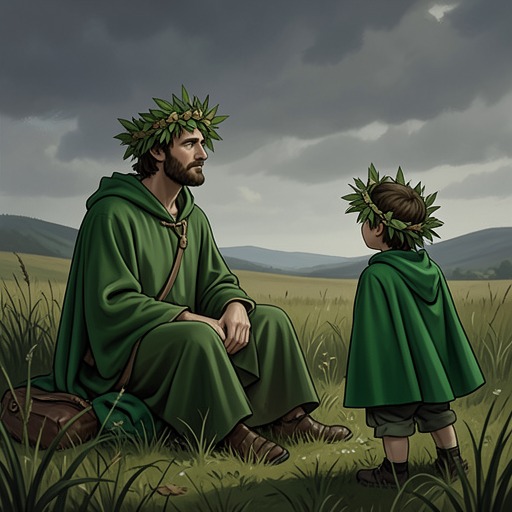
Warg is presented alongside “Shapechanger” and “Beastling” as a name that others might use for someone whose spirit enters an animal. When Jojen Reed identifies Bran Stark as a “Warg,” Bran is startled because he has understood his experiences as dreams. Jojen rejects that explanation: Bran’s closed eyes conceal an inner movement in which, as he drifts into sleep, his soul seeks out its other half. The force is described as unusually strong in him, making the wolf dreams evidence of an ability rather than meaningless fantasies.
The power is not represented as a voluntary skill that Bran can simply choose to acquire or discard. Bran wants to become a knight, but Jojen distinguishes between aspiration and nature: a knight is what Bran wants to be, while a warg is what he is. Jojen therefore treats denial as futile. Bran is called the “winged wolf,” yet also told that he will never fly unless he opens his eye, an image that makes awakening to the power both an opportunity and a demand.
Bran Stark’s Wolf Dreams
Bran’s experience of the ability begins in longing. He wishes that he were truly a direwolf because then he would understand the wolves’ song. In his wolf dreams he can race up jagged, icy mountains higher than any tower and stand beneath the full moon with the world below him. The dream offers a physical freedom denied to his waking body: Bran, who must pull himself around his room by iron bars and resists being carried, can move through the wolf’s body with speed and confidence.
The distinction between dream and waking life becomes unstable when Bran tests the connection directly. He howls from his window, producing a thin and uncertain human sound, but Summer answers with a deep voice and Shaggydog joins the chorus. Bran howls again, and the three voices become the sound of the last members of their pack. The scene is an act of communication as much as imitation. Bran cannot yet make a wolf’s howl, but the wolves respond to him, and his attempt places him within their shared emotional world.
The wolf’s perceptions can also carry grief and collective knowledge. Summer had howled when Bran fell, mourned while he lay broken, and joined Shaggydog and Grey Wind when the wolves sensed the death of Bran’s father. Bran does not fully understand the message when the wolves howl again, but he recognizes that it may announce another death: Robb Stark, Jon Snow, his mother, or one of his sisters. Warg perception therefore reaches beyond private fantasy into an animal form of awareness that Bran can feel before he can interpret it.
A later dream makes the connection more terrifying. Bran becomes a wolf pursuing an antlered stag through wet leaves and pine needles. He smells the stag’s fear, feels his heart thunder, tastes the excitement of the hunt, and climbs a wet, steep tree with claws that tear at the bark. When the wolf slips and falls, Bran wakes in bed with hard breathing and an aching shoulder, recognizing the pain as the ghost of what the wolf felt. The experience confirms Jojen’s interpretation: Bran is not merely imagining a wolf; he is sharing its sensations closely enough for the animal’s fear and injury to echo in his own body.
Fear, Danger, and Control
Jojen warns that knowledge of Bran’s nature could provoke fear among his own people. Some might hate him, and some might try to kill him, because stories told by Old Nan present beastlings and shapechangers as evil. Bran insists that he is not like those figures and that the experiences are only dreams. His protest shows the moral anxiety attached to the word warg: the ability is not automatically equated with wickedness, but the community may treat the person who possesses it as monstrous.
Bran’s inability to control the power leaves him vulnerable to the animal’s impulses. In the hunting dream, fury and hunger drive the wolf forward before conscious judgment can intervene. The animal’s body does not simply serve Bran as a vehicle; it supplies its own speed, appetite, fear, and physical limits. Warg identity is consequently a divided condition. Bran remains a child who wants knighthood, but he is also drawn into a nonhuman consciousness whose instincts can overwhelm his waking sense of self.
The connection is linked to isolation as well as strength. When Bran wakes from the dream of the falling wolf, he hears that Winterfell has been left with only a token garrison. The guards have been removed because Ser Rodrik Cassel needed every fighting-age man, while hundreds of soldiers have marched away and Torrhen’s Square is under attack. Bran’s supernatural perception arrives at a moment when ordinary protection has disappeared. He reaches for help through the bars and shouts for Hodor, Osha, Meera, and Jojen, but no one comes immediately; his power gives him knowledge and sensation without guaranteeing rescue.
Warg Dreams Beyond the North
Jon Snow’s experience extends the meaning of warg dreams beyond Bran’s personal awakening. After Ghost leaves him to hunt in the mountains, Jon sleeps and dreams of direwolves. There are five when there should be six, scattered and separated in a vast, cold forest. Jon feels emptiness and incompleteness, loses the scent of his brothers and sister, and cries into the dark for an answer. The dream turns family separation into animal geography: kinship is registered as scent, pack number, distance, and the silence that follows a call.
The Halfhand does not dismiss Jon’s account as childish superstition. Qhorin Halfhand calls it a wolf dream and suggests that it may be connected to the wildlings gathering near the source of the Milkwater or may show what waits ahead. When Jon reports it, the black brothers do not laugh; even Squire Dalbridge stops smiling. Ebben then asks whether Jon is a skinchanger, and Qhorin places the possibility within a larger pattern of returning ancient threats, saying that dead men walk and the trees have eyes again. In this setting, wargs and giants become plausible because the world itself is revealing that old stories may describe present realities.
Wolves, War, and Narrative Significance
Warg power also appears indirectly in the political stories told about Grey Wind. Rivers claims that the direwolf found a hidden goat track that allowed Robb Stark’s force to slip around the Tooth at night, moving single file beneath the Lannister watchtowers without being seen. The tale credits the animal with tactical perception and turns Grey Wind into an active participant in Robb’s victory. Rivers even repeats the grisly rumor that Robb fed Stafford Lannister’s heart to the wolf, though Catelyn Stark rejects the story and insists that her son is no savage. Whether or not the rumor is true, it shows how wolf-human bonds are transformed into legends of supernatural warfare.
Theon Greyjoy notices the practical and emotional force of the connection when the direwolves fall silent after the capture of Winterfell. He has grown so accustomed to their howling that he scarcely hears it, yet a hunter’s instinct registers its absence. The silence makes him uneasy, and he sends Urzen to discover what the wolves are doing, while ordering that Bran Stark and his younger brother be checked in their beds. The absence of animal sound becomes a warning before Theon possesses any clear explanation, demonstrating how the direwolves’ presence has altered the atmosphere and security of the castle.
The surviving wolves finally reappear amid the ruins of Winterfell. After the castle has been burned and emptied, with death surrounding Bran, Rickon Stark, Jojen Reed, Meera Reed, Osha, and Hodor, Shaggydog emerges from behind the broken tower and bounds happily toward Rickon. Summer advances more slowly, presses his head against Bran’s arm, and licks his face. Their return restores the broken pack at the very place where human protection and political order have collapsed. Warg is therefore both a supernatural condition and a narrative bridge between separated lives: it gives Bran access to animal knowledge, makes Jon’s isolation legible through pack imagery, and allows the wolves to register danger, grief, absence, and reunion before human characters can fully articulate them.